
Evaluating online business administration schools involves examining elements that define program quality, student experience, and academic recognition. Reviewers typically consider curriculum design, accreditation status, learning formats, faculty qualifications, assessment methods, student support services, and the technical platforms used to deliver instruction. The concept centers on matching program components to a learner’s academic goals and practical constraints, while assessing how those components align with broadly accepted educational standards.
Key evaluation themes include how courses are sequenced, whether learning outcomes are explicit and measurable, and how assessments measure applied skills. Additional practical considerations often cover transfer credit policies, practicum or capstone requirements, program length and estimated total cost, and availability of advising or career-related support. These factors may be weighted differently depending on individual needs, such as part-time study, prior credits, or intended professional pathways.

Curriculum structure is often one of the first comparison points. Programs may emphasize core business foundations—accounting, finance, management, marketing—followed by specialization electives. Typical undergraduate online programs often require a sequence of general education plus business-specific credits, which can range widely; graduate programs frequently focus on managerial analytics, strategy, and leadership. Careful review of course descriptions and stated learning outcomes can clarify whether a program’s content aligns with a learner’s expectations for applied or theoretical emphasis.
Accreditation and institutional recognition are frequently used as indicators of quality and transferability. Regional accreditation may indicate institutional oversight of academic standards, while programmatic accreditors assess specific business disciplines. Documentation of accreditation status, public access to program reviews, and transparency about credit transfer policies can provide evidence to evaluate. Accreditation status may also be useful to examine when considering employer or professional licensure expectations in particular fields.
Faculty qualifications and instructional design often influence the depth and relevance of coursework. Programs may employ faculty with academic doctorates, practitioner experience, or a combination of both; many online offerings pair recorded lectures with facilitated discussion and applied projects. Understanding faculty-to-student ratios, the frequency of instructor feedback, and the presence of industry-adjacent adjuncts may help gauge how much direct guidance a student can expect in an online setting.
Assessment methods and student support services contribute to the overall learning environment. Programs often combine formative assessments—quizzes, short assignments—with summative assessments—capstone projects, final exams, or portfolios. Robust student services may include academic advising, technical support, library access, and tutoring. Evaluators may consider how readily these services are available to remote learners and whether supports are synchronized with course timelines to reduce potential barriers to progression.
In summary, evaluating online business administration schools involves a systematic review of curriculum, accreditation, delivery format, faculty, assessment methods, and student supports. Observing how these elements interrelate can clarify whether a program’s design aligns with stated learning outcomes and practical constraints. The next sections examine practical components and considerations in more detail.
Curriculum content often determines how well a program prepares learners for analytical and managerial tasks. Many programs may organize core courses around accounting, statistics, organizational behavior, and finance, followed by electives or concentrations that explore subjects such as supply chain, entrepreneurship, or data analytics. Evaluators frequently review syllabi to check for clearly articulated learning objectives, alignment with assessment methods, and opportunities for applied projects that require integration of multiple skill areas.

Program credit and duration patterns may vary by level and institution. Undergraduate online business administration programs often require roughly 30–60 credits of business coursework in addition to general education requirements, while graduate programs commonly range from about 30 to 45 graduate credits. These figures may vary significantly across systems and countries, so it is typical to confirm specific credit-to-degree conversions and whether prior learning or transfer credits are accepted.
When assessing specialization tracks, consider how course sequencing supports skill progression. Specializations that include a capstone or practicum often require earlier coursework to build toward an integrative project. Evaluators may check whether elective offerings are updated regularly to reflect changes in business practice and technology, and whether course materials include contemporary case studies or datasets to practice analytical techniques.
Curriculum transparency is an important consideration. Clear course descriptions, sample syllabi, and published learning outcomes can help prospective learners and evaluators compare programs objectively. It is often useful to note whether learning outcomes are measurable—phrased in terms of competencies such as “apply financial analysis techniques” or “design a marketing plan”—which may make it easier to match program claims to assessment tasks and to later demonstrate skill attainment to external stakeholders.
Accreditation may take institutional or programmatic forms, each with a different focus. Institutional accreditation typically reviews overall governance, financial stability, and general academic quality, while programmatic accreditation evaluates discipline-specific curriculum rigor and faculty credentials. Evaluators often check accreditor websites for current status and scope of review. Transparent reporting of accreditation outcomes and any recent reviews or audits can be informative when comparing institutions.

Transfer credit policies and articulation agreements can influence time-to-completion for learners who hold prior credit. Some institutions may accept a high proportion of transfer credits from accredited providers, while others may limit acceptance to recent coursework or to courses with direct curricular equivalence. Documentation of transfer policy, residency requirements, and any required assessments for prior learning can reduce uncertainty for returning learners or those with previous postsecondary experience.
Recognition by professional associations or industry groups may add value for certain career pathways. For example, membership of faculty in recognized professional bodies or inclusion of content that maps to common professional competencies can be an indicator that program content aligns with sector expectations. Such affiliations do not guarantee outcomes, but they often serve as a reference point for how a program situates itself relative to professional standards.
Evaluators may also consider external quality indicators such as published graduation rates, student satisfaction surveys, and retention statistics when available. These metrics often require careful interpretation—differences in student populations, program delivery modes, and admission selectivity can affect rates—so they are typically best used alongside qualitative evidence from syllabi, faculty profiles, and support-service descriptions to form a balanced view.
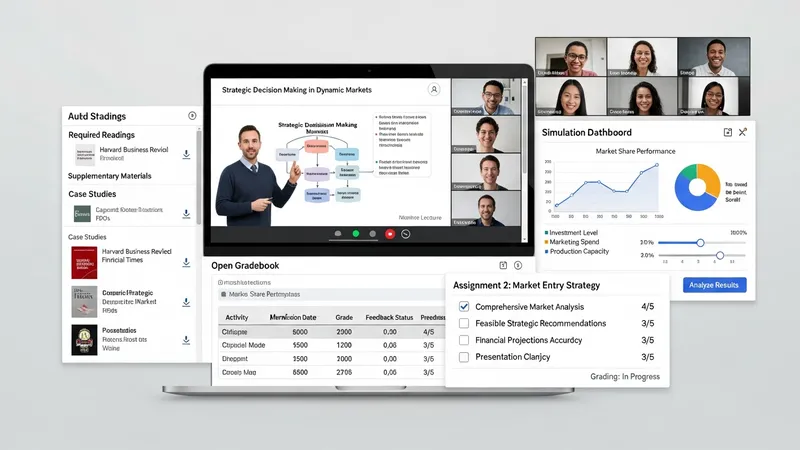
Instructional design in online business administration programs commonly uses a mix of recorded lectures, live discussions, readings, and applied assignments. Course design that integrates active learning—case analyses, simulations, or group projects—may support development of applied competencies. Evaluators often look for evidence of alignment between learning activities and assessment methods, and whether there are clear rubrics to communicate expectations for graded work.
Faculty qualifications frequently include a combination of academic credentials and practical experience. Many programs list faculty degrees, research interests, and professional backgrounds; these profiles can indicate the balance between theory and practice in instruction. Program evaluators may consider faculty workload in online settings, including availability for student interaction, grading turnaround times, and frequency of synchronous sessions if scheduled interaction is desired.
Assessment strategies vary and often include both individual and collaborative elements. Project-based assessments and capstone experiences can allow learners to synthesize knowledge across courses, while timed assessments may measure individual proficiency on specific topics. Evaluators typically examine sample assignments and rubrics to determine whether assessments are designed to measure stated learning outcomes and to support academic integrity in a remote environment.
Academic integrity measures and accommodation policies are also relevant. Common practices include proctoring options, honor codes, and plagiarism-detection tools, balanced with considerations for privacy and accessibility. Evaluators may note how institutions communicate these policies and whether academic support exists to help learners develop skills in research, writing, and ethical conduct before high-stakes assessments.
Student support services for online learners often encompass advising, tutoring, library access, and technical help desks. The availability and responsiveness of these services can influence persistence and completion rates. Evaluators may look for published hours of operation, modes of contact (email, chat, phone), and whether services are tailored for remote learners, such as virtual writing centers or online orientation modules that cover platform navigation and academic expectations.

Technical requirements and platform stability are practical considerations. Programs often specify minimum hardware, browser, and bandwidth requirements, and they may provide recommendations for optimal user experience. Evaluators may examine whether institutions offer trial access or system checks, and whether alternative submission methods exist in case of technical disruptions. Clear guidance can reduce barriers for learners with varied connectivity or device access.
Evaluation frameworks used to compare programs can be multi-dimensional, combining curriculum alignment, accreditation status, faculty qualifications, student-support availability, and assessment design. Frameworks that weight elements transparently and use verifiable evidence—published syllabi, accreditation reports, and service hours—may support more objective comparisons. It is common to favor frameworks that allow adjustments for individual priorities, such as part-time study schedules or prior credit recognition.
Finally, consider longitudinal indicators where available, such as reported alumni outcomes or employer feedback, recognizing that such data may be limited and influenced by external conditions. When interpreting outcome data, evaluators often contextualize figures with enrollment composition, program age, and delivery mode. These contextual notes can help form a measured understanding of how a given program’s design and supports align with intended educational outcomes.