
The revenue cycle in healthcare refers to the sequence of administrative and clinical tasks that begin when a person first requests services and end when payment for those services is recorded. This sequence typically covers collecting demographic and insurance data, confirming coverage and eligibility, translating clinical encounters into billable codes, sending claims to payers, receiving payments, and reconciling accounts. The process combines front-office interactions, back-office billing activities, and technical interfaces that move information between providers, payers, and patients.
Within this sequence, accuracy and timeliness are central concerns because errors at early stages can propagate and affect claim adjudication and cash flow. Different functions may be supported by specialized tools or workflows: electronic intake platforms to capture patient data, automated verification services to check benefits, coding tools to assign procedure and diagnosis codes, claim scrubbing to reduce errors before submission, and posting systems to record payments and adjustments. Each stage may involve documentation, quality checks, and compliance with privacy and billing rules.
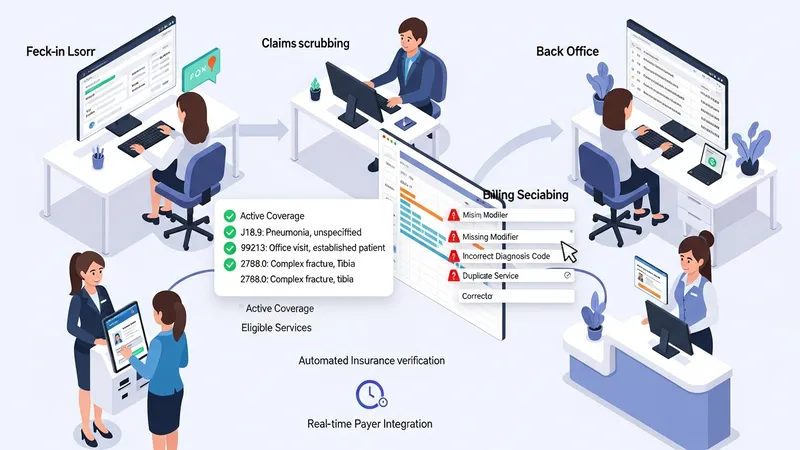
Front-end intake systems often aim to reduce manual entry and improve data quality by using structured fields and validation rules. Electronic registrations can typically integrate with scheduling and electronic health record (EHR) systems so that demographic and insurance data flow forward without rekeying. Accurate collection of primary and secondary payer details, address verification, and consent documentation may reduce downstream denials. Some platforms also include patient-facing portals to capture pre-visit forms which can shorten in-clinic processing times and help staff focus on verification tasks.
Insurance eligibility and benefits checks may occur at multiple points: at scheduling, at check-in, and prior to certain services where prior authorization is commonly required. Automated verification services can often query payer systems or use data aggregators to return coverage status and cost-share estimates; however, returned results may vary by payer and plan and typically require staff review for complex cases. Early verification may help set appropriate expectations for financial responsibility and identify coverage limitations that could affect coding or authorization requirements.
Coding and claims preparation rely on accurate clinical documentation and standardized code sets. Coders and coding software often translate documented diagnoses and procedures into codes such as ICD and CPT (or other regional equivalents). Claim-scrubbing tools apply edits to detect missing or inconsistent elements, which may reduce rejections at the payer gateway. Nevertheless, ambiguous documentation or clinical detail gaps can lead to coder queries or claims adjustments; maintaining clinical documentation integrity processes can help align clinical notes with billing requirements.
Payment posting and reconciliation close the administrative loop by matching remittance advice to posted payments and adjustments. Electronic remittance advice (ERA) and electronic funds transfer (EFT) formats may automate parts of posting, but exceptions and partial payments often require manual review. Accurate posting supports aging reports and revenue analytics and may affect patient billing statements. Reconciliation processes typically identify differences between expected and received amounts, categorizing them for follow-up such as appeals, refunds, or contractual adjustments.
In summary, the series of steps from initial contact through final posting describes a coordinated set of administrative and clinical activities that together influence cash flow, compliance, and patient experience. The examples listed — registration platforms, eligibility services, and coding/billing software — illustrate common tool types used across these stages and may integrate to varying degrees. The next sections examine practical components and considerations in more detail.
Patient intake typically begins with demographic capture, consent collection, and preliminary clinical screening. Digital registration platforms can structure data fields to reduce free-text entry and may include validation rules for addresses, dates of birth, and payer identifiers. Systems that integrate with scheduling and EHR modules often pass information forward to reduce duplicate entry. Considerations include data privacy safeguards, accessibility for patients, and workflow adjustments so staff can verify insurance identifiers and capture secondary payer information. Accurate intake may reduce downstream administrative follow-up and support clearer patient statements.

Front-office staff may use checklists or automated prompts to confirm insurance card details, emergency contacts, and consent forms. Some registration solutions enable pre-visit completion through secure portals, which can shorten on-site processing and surface potential eligibility issues before the encounter. Identity verification and consent management can also support compliance with privacy regulations. While digital tools can streamline intake, organizations typically balance automation with staff review to address complex cases such as bundled services or multi-payer billing situations.
Capturing estimated patient financial responsibility during intake is often a multi-step activity that may involve benefit estimation engines or simple payer lookup. Estimates can vary depending on plan design, deductibles, and coverage limits; therefore, many organizations view these figures as indicative rather than definitive. Clear communication of estimated responsibilities, along with documented attempts to verify benefits, may reduce disputes and support eventual reconciliation during payment posting. Staff training on how to explain estimates neutrally may assist patient understanding.
Operational metrics tied to intake commonly include capture rates for insurance data, percentage of registrations completed pre-visit, and time spent per registration. Improving these metrics often requires iterative adjustments to forms, staff processes, and technology interfaces. Data quality audits and periodic reviews of denial causes related to intake data may inform targeted improvements. These considerations may help organizations optimize front-end workflows while maintaining accurate records for downstream coding and claims processes.
Coding transforms clinical documentation into standardized codes used for billing and reporting. Accurate clinical notes that reflect diagnosis specificity and procedure details are essential for precise code assignment. Coding teams may use software that suggests codes based on documentation and applies logic checks to identify inconsistencies. Coding quality reviews, such as audits or clinical documentation improvement programs, can surface recurring documentation gaps that influence claim accuracy. Organizations often pair coder feedback loops with clinician education to improve source documentation and reduce later coding revisions.
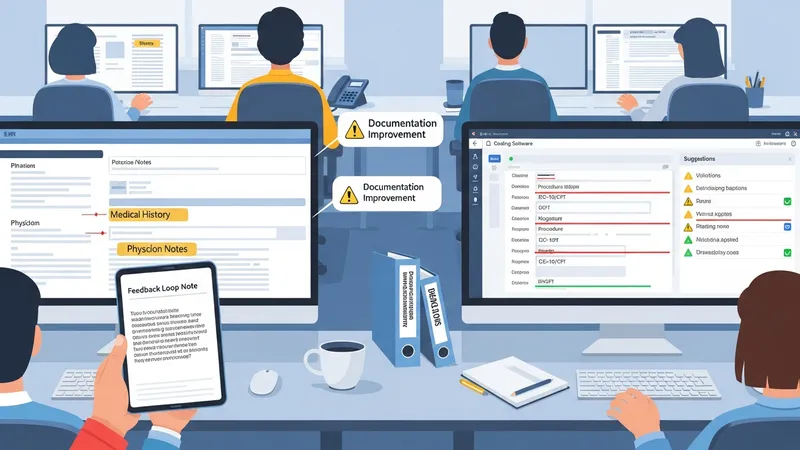
Claim preparation frequently includes validation steps such as format checks, payer-specific requirements, and edits for missing fields. Claim-scrubbing tools can flag inconsistencies like mismatched provider identifiers, unbundled procedures, or missing modifiers. These tools may reduce initial rejections but cannot resolve all clinical or contractual issues. When claim edits are generated, designated staff usually review the flagged items, correct documentation if appropriate, and resubmit. This iterative process may affect throughput and timing for submission windows required by some payers.
Standard code sets such as diagnosis and procedure classifications are updated periodically; staying current with updates is a routine operational task for coding teams. Changes in coding guidance or payer policies can influence reimbursement and may require coordinated updates to templates, coder education, and internal policies. Organizations commonly track coding-related denials and monitor their root causes to guide process improvements. Such monitoring may reveal whether denials originate from documentation, code selection, or payer adjudication rules.
Key internal controls for coding and claims preparation typically include segregation of duties, version control for code mappings, and periodic audit sampling. These measures aim to maintain accuracy and compliance while supporting efficient claim throughput. Reporting on coding accuracy rates, claim rejection rates at submission, and average time from encounter to claim submission can help administrators evaluate whether processes and tools are functioning as intended.
Claims are usually transmitted electronically via clearinghouses or directly to payer portals depending on payer requirements and organizational arrangements. Clearinghouses may perform additional edits and route claims to the correct payer, and they often provide status notifications that help track transmission success. Submission timing and frequency can influence cash flow; many organizations batch claims by service date or provider schedule. Understanding each payer’s claim format and business rules is important for reducing transmission-level rejections and avoiding resubmission delays.

Electronic remittance advice (ERA) and electronic funds transfer (EFT) formats facilitate automated posting of payments and adjustments in many systems. When direct automation is used, remittance lines are matched to open claims and patient accounts and may update balances automatically. However, partial payments, denial adjustments, and contractual write-offs often require human review to assign appropriate account codes. Procedures to handle exceptions and outliers typically involve collaboration between posting staff and the billing or appeals team.
Reconciliation processes compare expected contractual amounts to what was posted, identifying variances such as underpayments, bundling differences, or payer adjustments. Regular reconciliation cycles may occur daily or weekly depending on claim volume and reporting needs. Detailed posting practices can affect measures like days in accounts receivable (A/R), and clear documentation of adjustment reasons supports accurate financial reporting. Maintaining a consistent chart of accounts and standardized adjustment codes can aid in downstream analysis.
Operational monitoring for submission and posting often includes metrics such as claim acceptance rate, days from service to submission, payment lag, and remittance exception volume. These indicators may guide staffing levels, rule updates in claim-scrubbing tools, and decisions about outsourcing certain functions. Transparent handoffs and documented processes for clearinghouse interactions and posting exceptions may reduce rework and support clearer financial visibility.
Denial management focuses on identifying why claims were not fully paid and on pursuing corrective actions when appropriate. Common denial reasons include eligibility discrepancies, coding mismatches, lack of prior authorization, and billing errors. Effective workflows typically categorize denials by root cause, assign responsibility for follow-up, and track outcomes such as successful appeals or final write-offs. Aggregating denial reasons can reveal systemic issues that may be addressed through targeted training, documentation improvements, or payer negotiations.

Performance metrics used to evaluate revenue cycle health often include denial rate, average days in A/R, clean claim rate, point-of-service collections, and net collection rate. These metrics may be calculated differently across organizations, so maintaining clear definitions and consistent measurement intervals is important for trend analysis. Monitoring these indicators can help prioritize process improvements and allocate resources to stages that most affect cash flow or administrative burden.
Financial reporting derived from the revenue cycle combines transaction-level details into summaries used for operational and strategic decisions. Accurate cost-centers, patient account reconciliation, and timely posting of payments and adjustments are prerequisites for reliable reports. Reports may feed into budgeting, forecasting, and compliance activities; therefore, data integrity controls and documentation for adjustments support auditability. Periodic reviews of aging schedules and reconciliation logs can help identify long-standing receivables requiring special attention.
Continuous improvement efforts often pair quantitative monitoring with qualitative reviews such as staff interviews or chart reviews to understand underlying causes of performance gaps. Incremental changes to workflows, software configurations, or documentation practices may be implemented and monitored for impact. Over time, organizations may adopt integrated platforms or modular toolsets depending on scale, aiming for clearer visibility across intake, coding, claims, posting, and denial workflows while preserving appropriate controls and compliance safeguards.